
Thursday, October 9, 2014


Beat 'ya to it, Charlie!
I woke up at 4 yesterday morning to watch the eclipse. It had rained pretty hard during the night so I wasn't sure if it would be clear enough to see anything. Bundled up -grabbed a mug of hot coffee and went outside. It was cold, windy and the deck was wet with puddles. Charlie heard me, crowed a few time and then went back to sleep! (Why doesn't he do that all the time?)
The night sky was amazing - no clouds and the moon was bright and crystal clear! Usually only on Winter nights does it look that way. If only ALL the leaves were off , I could have taken better pictures. These are three of the nicer ones taken right before the moon disappeared behind the trees.


The night sky was amazing - no clouds and the moon was bright and crystal clear! Usually only on Winter nights does it look that way. If only ALL the leaves were off , I could have taken better pictures. These are three of the nicer ones taken right before the moon disappeared behind the trees.
Would be silly to go back to bed, so I waited for the sun to come up and it was worth the wait:
And yes, the gang got an early breakfast!
Wednesday, October 8, 2014
The Friesian
These magnificent horses are only two minutes down the road from our house! Every morning I can hear them whinny when they are let out for the day. I love to watch them run with their manes and tails sailing in the wind!


From: Wikipedia, the free encyclopedia:
The breed was developed in the province of Friesland in the northern Netherlands, where there is evidence of thousands of years of horse populations, and this breed is said to have descended from the primitive forest horse.
Ancestors of the modern Friesians were used in medieval times to carry knights to battle. In the 12th and 13th centuries, some eastern horses of crusaders were mated with Friesian stock. During the 16th and 17th centuries, when the Netherlands were briefly linked with Spain, there was less demand for heavy war horses, as battle arms changed and became lighter. Andalusian horses were bred with Friesians, producing a lighter horse more suitable (in terms of less food intake and waste output) for work as urban carriage horses.
Historian Ann Hyland wrote of the Friesian breed:
The Emperor Charles (reigned 1516 -56) continued Spanish expansion into the Netherlands, which had its Frisian warhorse, noted by Vegetius and used on the continent and in Britain in Roman times. Like the Andalusian, the Frisian bred true to type. Even with infusions of Spanish blood during the sixteenth century, it retained its indigenous characteristics, taking the best from both breeds. The Frisian is mentioned in 16th and 17th century works ... a courageous horse eminently suitable for war, lacking the volatility of some breeds or the phlegm of very heavy ones. Generally black, the Frisian was around 15hh with strong, cobby conformation, but with a deal more elegance and quality. The noted gait was a smooth trot coming from powerful quarters. Nowadays, though breed definition is retained, the size has markedly increased, as has that of most breeds due to improved rearing and dietary methods.
The breed was especially popular in the 18th and 19th centuries, when they were in demand not only as harness horses and for agricultural work, but also for the trotting races so popular then. The Friesian may have been used as foundation stock for such breeds as the Dole Gudbrandsdal, the Norfolk Trotter (ancestor of the Hackney), and the Morgan.] In the 1800s, the Friesian was bred to be lighter and faster for trotting, but this led to what some owners and breeders regarded as inferior stock, so a movement to return to pureblood stock took place at the end of the 19th century.
A Studbook Society was founded in 1879 by Frisian farmers and landowners who had gathered to found the Friesian Cattle Registry (FRS,] The Paardenstamboek ("Stud book") was published in 1880 and initially registered both Friesian horses and a group of heavy warmblood breeds, including East Friesians and Oldenburgers, collectively known as "Bovenlanders".] At the time, the Friesian horse was declining in numbers, and was being replaced by the more fashionable Bovenlanders, both directly, and by crossbreeding Bovenlander stallions on Friesian mares. This had already virtually exterminated the pure Friesian in significant parts of the province in 1879, which made the inclusion of Bovenlanders necessary. While the work of the registry produced a revival of the breed's popularity in the late 19th century, it also resulted in the sale and disappearance of many of the best stallions from the breeding area, and Friesian horse populations dwindled. By the early 20th century, the number of available breeding stallions was down to three. Therefore, in 1906, the two parts of the registry were joined, and the studbook was renamed the Friesch Paarden Stamboek (FPS) in 1907."Friesian horses are sometimes referred to as "Belgian Blacks"
In 1913, a society known as the Het Friesch Paard was founded, dedicated to the protection and promotion of the breed. By 1915, the group convinced FPS to split the registries back up into two groups. By 1943, the breeders of non-Friesian horses left the FPS completely to form an entirely separate registry, which later became the Koninklijk Warmbloed Paardenstamboek Nederland (Royal Warmblood Studbook of the Netherlands (KWPN).
Displacement by petroleum-powered farm equipment on dairy farms also was a threat to the survival of Friesian horse. The last draught function performed by Friesians on a significant scale was on farms that raised dairy cattle. World War II slowed down the process of displacement, allowing the breed's population and popularity to rebound. Important in the initial stage of the breed's rebound was the circus of the Strassburger family, who, having fled Nazi Germany for the Low Countries, discovered the show qualities of the breed and demonstrated its abilities outside of its local breeding area during and after the Nazi occupation.[citation needed]
Today, there are three modern bloodlines: Tetman 205, Age 168, and Ritske 202. Each of these sires traces his blood to Paulus 121, born in 1913 and entered into the Studbook in 1916. He, in turn, can be traced back three generations to the original 19th-century Studbook foundation sire, Nemo 51, born in 1885. All purebred Friesians trace back to these bloodlines.
From: Wikipedia, the free encyclopedia:
Friesian horses
The breed was developed in the province of Friesland in the northern Netherlands, where there is evidence of thousands of years of horse populations, and this breed is said to have descended from the primitive forest horse.
Ancestors of the modern Friesians were used in medieval times to carry knights to battle. In the 12th and 13th centuries, some eastern horses of crusaders were mated with Friesian stock. During the 16th and 17th centuries, when the Netherlands were briefly linked with Spain, there was less demand for heavy war horses, as battle arms changed and became lighter. Andalusian horses were bred with Friesians, producing a lighter horse more suitable (in terms of less food intake and waste output) for work as urban carriage horses.
Historian Ann Hyland wrote of the Friesian breed:
The Emperor Charles (reigned 1516 -56) continued Spanish expansion into the Netherlands, which had its Frisian warhorse, noted by Vegetius and used on the continent and in Britain in Roman times. Like the Andalusian, the Frisian bred true to type. Even with infusions of Spanish blood during the sixteenth century, it retained its indigenous characteristics, taking the best from both breeds. The Frisian is mentioned in 16th and 17th century works ... a courageous horse eminently suitable for war, lacking the volatility of some breeds or the phlegm of very heavy ones. Generally black, the Frisian was around 15hh with strong, cobby conformation, but with a deal more elegance and quality. The noted gait was a smooth trot coming from powerful quarters. Nowadays, though breed definition is retained, the size has markedly increased, as has that of most breeds due to improved rearing and dietary methods.
The breed was especially popular in the 18th and 19th centuries, when they were in demand not only as harness horses and for agricultural work, but also for the trotting races so popular then. The Friesian may have been used as foundation stock for such breeds as the Dole Gudbrandsdal, the Norfolk Trotter (ancestor of the Hackney), and the Morgan.] In the 1800s, the Friesian was bred to be lighter and faster for trotting, but this led to what some owners and breeders regarded as inferior stock, so a movement to return to pureblood stock took place at the end of the 19th century.
A Studbook Society was founded in 1879 by Frisian farmers and landowners who had gathered to found the Friesian Cattle Registry (FRS,] The Paardenstamboek ("Stud book") was published in 1880 and initially registered both Friesian horses and a group of heavy warmblood breeds, including East Friesians and Oldenburgers, collectively known as "Bovenlanders".] At the time, the Friesian horse was declining in numbers, and was being replaced by the more fashionable Bovenlanders, both directly, and by crossbreeding Bovenlander stallions on Friesian mares. This had already virtually exterminated the pure Friesian in significant parts of the province in 1879, which made the inclusion of Bovenlanders necessary. While the work of the registry produced a revival of the breed's popularity in the late 19th century, it also resulted in the sale and disappearance of many of the best stallions from the breeding area, and Friesian horse populations dwindled. By the early 20th century, the number of available breeding stallions was down to three. Therefore, in 1906, the two parts of the registry were joined, and the studbook was renamed the Friesch Paarden Stamboek (FPS) in 1907."Friesian horses are sometimes referred to as "Belgian Blacks"
In 1913, a society known as the Het Friesch Paard was founded, dedicated to the protection and promotion of the breed. By 1915, the group convinced FPS to split the registries back up into two groups. By 1943, the breeders of non-Friesian horses left the FPS completely to form an entirely separate registry, which later became the Koninklijk Warmbloed Paardenstamboek Nederland (Royal Warmblood Studbook of the Netherlands (KWPN).
Displacement by petroleum-powered farm equipment on dairy farms also was a threat to the survival of Friesian horse. The last draught function performed by Friesians on a significant scale was on farms that raised dairy cattle. World War II slowed down the process of displacement, allowing the breed's population and popularity to rebound. Important in the initial stage of the breed's rebound was the circus of the Strassburger family, who, having fled Nazi Germany for the Low Countries, discovered the show qualities of the breed and demonstrated its abilities outside of its local breeding area during and after the Nazi occupation.[citation needed]
Today, there are three modern bloodlines: Tetman 205, Age 168, and Ritske 202. Each of these sires traces his blood to Paulus 121, born in 1913 and entered into the Studbook in 1916. He, in turn, can be traced back three generations to the original 19th-century Studbook foundation sire, Nemo 51, born in 1885. All purebred Friesians trace back to these bloodlines.
Can you just imagine the thrill it must be to ride a horse like that?

A ride into town...
Not much going on - Just went in to town....
 |
| No traffic at all |
 |
| Some trees are bare already |
 |
| And some are just starting to change |
 |
| Uh-oh! Traffic ahead! |
 |
| Heading back |
 |
| I hate this S" bend - it's narrow and has a huge blind spot |
 |
| Where we turn off on the left |
 |
| One of the smaller farms |
 |
| The town recently graveled and oiled the road. Pot holes all gone! |
 |
| Some of the cows from the farm pictured below |
 |
| The milk tanker had just left |
 |
| And when we got home: two eggs! |
Some-days it's just like a whirlwind around here, 'ya know :o)
Tuesday, October 7, 2014
Don't miss it!
From: http://spaceweather.com
DON'T MISS THE LUNAR ECLIPSE: On Wednesday morning, Oct. 8th, there will be a total lunar eclipse.
Sky watchers in the Americas, Australia and most of Asia can see the
full Moon turn red as it passes through the sunset-colored shadow of
Earth: visibility map.
The show begins at approximately 9:15 UT (2:15 a.m. PDT) when the Moon
makes first contact with the core of Earth's shadow. Totality, when the
Moon is fully shadowed, begins at 10:25 UT (3:25 a.m. PDT) and lasts
for nearly an hour. Resources: NASA video, animated eclipse, live webcast.
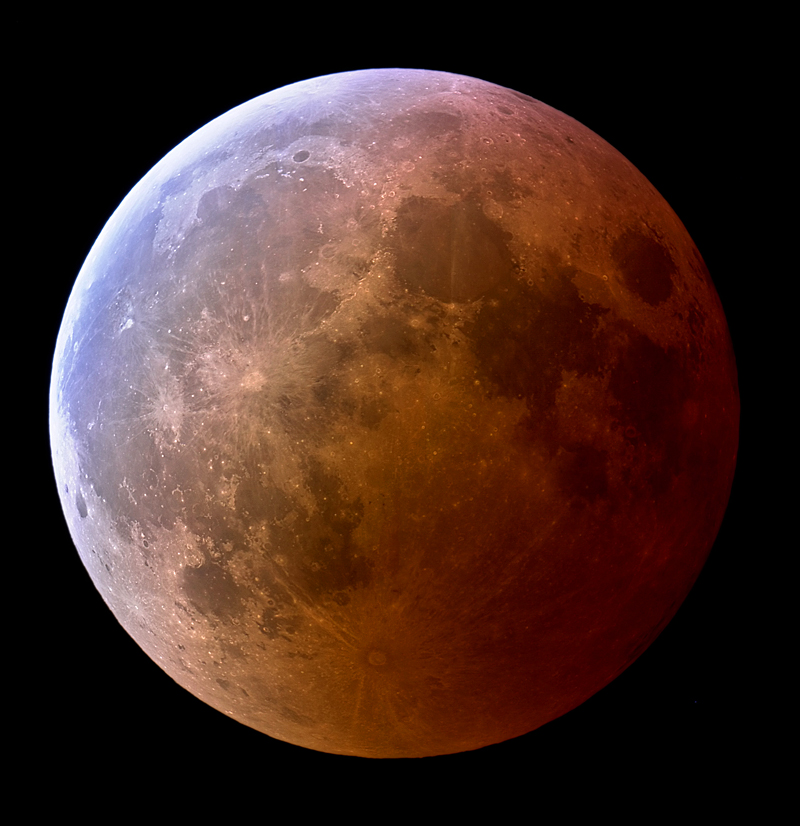
During the eclipse, the Moon will look like this:

The hue of the lunar disk
may seem puzzling to some readers. Shadows are supposed to be black, yet
the shadowed Moon is mostly bright red. A quick trip to the Moon
explains the color:
Imagine yourself standing
on a dusty lunar plain looking up at the sky. Overhead hangs Earth,
nightside down, completely hiding the sun behind it. The eclipse is
underway. You might expect Earth seen in this way to be utterly dark,
but it's not. The rim of the planet is on fire! As you scan your eye
around Earth's circumference, you're seeing every sunrise and every
sunset in the world, all of them, all at once. This incredible light
beams into the heart of Earth's shadow, filling it with a coppery glow
and transforming the Moon into a great red orb.
Red isn't the only color,
however. Sharp-eyed observers might also spot some turquoise, shown here
in a photo taken by Jens Hackman during an eclipse in March of 2007:
Its source is ozone.
Atmospheric scientist Richard Keen of the University of Colorado
explains: "During a lunar eclipse, most of the light illuminating the
moon passes through the stratosphere where it is reddened by
scattering. However, light passing through the upper stratosphere
penetrates the ozone layer, which absorbs red light and actually makes
the passing light ray bluer." This can be seen, he says, as a soft
blue fringe around the red core of Earth's shadow.
To catch the turquoise on Oct. 8th, he
advises, "look during the first and last minutes of totality. The
turquoise rim is best seen in binoculars or a small telescope."Look at what she found!
Neighbor called me over to take a look at what she found in her weeping cranberry tree:


From: http://www.wasp-removal.com/wasp-nest.php
Wasp nests grow at varying rates depending on a variety of factors.
Food availability in early summer is a big factor in the growth of a wasp nest. If there is a shortage of food in early summer, the numbers of individual wasps will not be as high as "normal" years.
Available nest material is also important. Wasps strip untreated dead wood from fence panels or garden furniture and sheds which is converted into a paste that the wasps use to construct their nest.
 Despite age old rumours and misunderstandings, wasps do not swarm in
the same fashion as honey bees. Wasps only swarm around the nest
location when the nest is tampered with (under attack) such as when a
nest is treated. Wasps do swarm when feeding, but this will not be in
the area of the nest and not in the same fashion as honey bees.
When foraging scout wasps find a source of food, they return to the nest to communicate the location of the new food source. In late summer/autumn when wasps no longer have food supply in the nest, they can become a problem as they interact and compete with humans for sugary type foods, pub gardens are a good example.
In midsummer onwards into late autumn you will be able to easily tell if a nest is active or live. Take a few moments to watch the nest from a safe distance. If you can see wasps walking over the outside of the nest then it's live. Similarly if you can see wasps arriving at the nest and also leaving, the nest is live.
The queen will lay eggs in each cell as it is being constructed. Once these eggs have hatched out and gone through the developments stages and pupated into adult wasps, these new worker wasps take over nest construction and leave the queen solely to lay eggs and control the nest, this from now on is her primary function!
Read more detailed information about the wasp life-cycle and how wasp nests are built
The workers take this material back to the nest and hand it over to young wasp larvae which turn this chewed wood into a paste which the adult workers then use to continue expanding the nest. The paste which is used to construct the nest contains a certain amount of wax which helps with waterproofing.

How cool is that?!!
From: http://www.wasp-removal.com/wasp-nest.php
How wasp nests are constructed
The Wasp nest is a fascinating piece of engineering constructed from wood which the wasps strip from fence panels and garden sheds etc. The queen wasp starts building the nest from scratch in the spring after she emerges from winter hibernation (You can read about the life-cycle of the wasp).Wasp nests grow at varying rates depending on a variety of factors.
Food availability in early summer is a big factor in the growth of a wasp nest. If there is a shortage of food in early summer, the numbers of individual wasps will not be as high as "normal" years.
Available nest material is also important. Wasps strip untreated dead wood from fence panels or garden furniture and sheds which is converted into a paste that the wasps use to construct their nest.
Despite age old rumours and misunderstandings, wasps do not swarm in
the same fashion as honey bees. Wasps only swarm around the nest
location when the nest is tampered with (under attack) such as when a
nest is treated. Wasps do swarm when feeding, but this will not be in
the area of the nest and not in the same fashion as honey bees.When foraging scout wasps find a source of food, they return to the nest to communicate the location of the new food source. In late summer/autumn when wasps no longer have food supply in the nest, they can become a problem as they interact and compete with humans for sugary type foods, pub gardens are a good example.
In midsummer onwards into late autumn you will be able to easily tell if a nest is active or live. Take a few moments to watch the nest from a safe distance. If you can see wasps walking over the outside of the nest then it's live. Similarly if you can see wasps arriving at the nest and also leaving, the nest is live.
How Wasp Nests are made
The nest starts off in the spring with the queen building a petiole (a single stalk from which the nest hangs) and a single hexagonal shaped cell at the end of the petiole, then approx six more cells are formed around the centre one.The queen will lay eggs in each cell as it is being constructed. Once these eggs have hatched out and gone through the developments stages and pupated into adult wasps, these new worker wasps take over nest construction and leave the queen solely to lay eggs and control the nest, this from now on is her primary function!
Read more detailed information about the wasp life-cycle and how wasp nests are built
Why are some wasps aggressive and some calm?
The queen also determines the “mood” of the nest, some are very aggressive, some are not so, it all depends on the individual queen. She emits a pheromone throughout the nest that signals to the workers that either everything is ok, or the nest is in danger etc.What is a wasp nest made from?
The wasp nest is made from chewed wood, as nests are being established in the spring the queen wasp will start to gather old dead wood from untreated fence panels or sheds, even garden furniture. As the nest progresses and worker wasps have hatched, they take over nest material collection duties.The workers take this material back to the nest and hand it over to young wasp larvae which turn this chewed wood into a paste which the adult workers then use to continue expanding the nest. The paste which is used to construct the nest contains a certain amount of wax which helps with waterproofing.
How cool is that?!!
Subscribe to:
Posts
(
Atom
)