All aboard - we're off to Australia! Lots of steam, and a beautiful countryside!
Within a few years of the introduction of the A2 class 4-6-0 in 1907,
it was clear that increasingly heavy train loads would require a more
powerful locomotive on principal main lines. From as early as 1918, a
series of drawings for potential
4-6-2
'Pacific' type locomotives began to emerge from the VR's Locomotive
Design Section, some of which were ultimately developed into the 3
cylinder
S class heavy Pacific of 1928.
[1]
However, plans for a smaller 2 cylinder Pacific, with an axle load
below 20 tons to allow operation across the VR mainline network, were
put on hold during the 1930s. This was partly due to the decline in
traffic and revenue due to the
Great Depression, and partly due to the improved power outputs and efficiency from the A2 locomotives after the application of a series of
smokebox design and draughting changes referred to as
'Modified Front End' in the mid-1930s.
By 1943 however, the situation had changed. There was a massive increase in traffic brought by the advent of
World War II,
and the A2s were by this point well past their prime. The VR Locomotive
Design Section once again turned their attention to the proposed
Pacific replacement. The addition of a
mechanical stoker, the enlarging of the
grate from 37 to 42 square feet (3.4 to 3.9 m
2)
for increased performance and the use of heavy bar-frame construction
for increased durability significantly increased the projected weight of
the locomotive. To keep the
axle load to 19.5 tons, the design by 1944 had changed from a 4-6-2 'Pacific' to a
4-6-4 'Hudson' wheel arrangement.
[2]
Design Features
The R class reflected an ongoing evolution of VR locomotive design
and a response to the changing operational environment of the VR in the
postwar era.
The R class adopted the bar frame construction of the
H and
S
class express passenger locomotives, which had proven to be far more
robust in coping with the VR's varying track quality than the
fracture-prone plate frames of the A2.
The decision to install MB Type 1
mechanical stoker equipment (capable of feeding up to 10,000 lb (4,536 kg) of coal per hour)
[3] on a locomotive with only a 42-square-foot (3.9 m
2)
grate reflected improved postwar working conditions for locomotive
firemen, the varying quality of postwar coal and the expectation of
sustained high speed operation of the locomotive. The manually fired
prewar VR S class
Pacific, although capable of 2,300
drawbar horsepower (1,700
kW), was limited by the physical ability of the fireman to feed its 50-square-foot (4.6 m
2) grate and as such was reliant on coal with a high calorific value.
[4]
Online locomotive database steamlocomotive.com notes: "They showed an
interesting blend of European, British, American, and Australian
practice. The slotted pilot is Australian, the long sand dome American,
the Belpaire firebox and cab British, and the mid-line smoke lifters
('elephant ears') European."
[5]
Other modern features included
SKF roller bearings on all axles and the innovative, lightweight
SCOA-P type
driving wheels, which were specially developed for the R class by the Steel Company of Australia.
[6]
Production
An order for 20 locomotives was placed with the VR's
Newport Workshops
in 1946, but remained unfulfilled for years as shortages of steel and
manpower saw other projects (such as the overhaul of badly run-down
infrastructure and the building of extra
X class goods locomotives) given precedence.
[7]
By the late 1940s, the A2 class was at the end of its life, and new
motive power was desperately required. Australian Federal Government
restrictions on the availability of US dollars (designed to favour trade
within the British Empire) precluded the VR from purchasing American
diesel-electric locomotives.
[8]
The VR broke with a long standing policy of in-house steam locomotive
construction and called for tenders to construct an additional 50 R
class. The contract was awarded to
North British Locomotive Company
in Glasgow, Scotland on 21 September 1949. The order was increased to
70 on 12 January 1950 with the cancellation of the original order of 20
locomotives from VR's Newport shops. Parts manufactured for the Newport
order were used to complete the NBL-built locomotives.
Further delays were experienced once the locomotives finally arrived
from May 1951 onwards. Corrosion had already set in during their sea
voyage as deck cargo from Scotland to Australia, and there were numerous
manufacturing defects requiring rectification. R 703 was the first of
the class in service, on 27 June 1951, and the last of the fleet R 769
did not enter service until 23 September 1953.
[7]
Service life

R 730, hauling a Melbourne-Dimboola passenger service, at
Parwan railway station, Victoria, 1953. This locomotive was the last of the class to be scrapped, on 13th October 1969.
[9]
Once the manufacturing defects and corrosion damage were corrected,
the R class proved to be a fine locomotive in its intended role of
express passenger service. Dynamometer car testing showed they were
capable of producing a maximum 1840
drawbar horsepower (1,372 kW) at 37.5 mph (60.4 km/h),
[10] a significant improvement over the A2's 1,230 hp (920 kW) at 32 mph (51 km/h).
[11]
They quickly took over virtually all mainline passenger services
previously operated by the A2 and passenger timetables were revised to
take advantage of their higher performance, with cuts to journey times
as high as 60 minutes.
[12] Individual R class locomotives were soon running upwards of 950 to 1,250 miles (1,530 to 2,010 km) each per week.
[13]
Their mechanical stoker, smooth riding characteristics and large, comfortable cab also made them popular with crews.
The R's impressive debut was cut short by the introduction of the
B class (EMD ML2)
diesel electric locomotives from July 1952, a locomotive type based on the latest
GM EMD designs and built in Australia under licence by
Clyde Engineering. By the end of 1953, the success of the B class saw the R class withdrawn from
The Overland service to
Adelaide and also VR's passenger service to
Mildura. The
Gippsland line, which was electrified to
Traralgon
by 1955, was the first line to see the complete withdrawal of the R
class from service. On 18 May 1964, R 703 worked the last regular
steam-hauled passenger train out of Melbourne, the 6.05pm Geelong
service.
[14]
The Rs were pressed into secondary passenger and goods service, roles
which for which a Hudson with large diameter driving wheels was
sometimes a less than ideal choice. There was little opportunity to
exploit their high speed capability. Furthermore, their relatively low
factor of adhesion
(4.08) and lack of fully compensated springing, coupled with the
tendency of locomotives to transfer weight to the rearmost wheels under
high drawbar pull conditions (which in the case of the R meant a weight
transfer from the driving wheels to the unpowered trailing truck) caused
them to
slip when starting heavy goods trains.
[15]
The R class is remembered by many for its role as power for the
seasonal grain harvest. In times of a good harvest, virtually every
available locomotive would be marshalled into service to shift wheat
trains of over 1,000 tons from Victoria's Western district through to
the ports for export. Double-headed R class locomotives, sometimes aided
by a third R acting as banking engine at the rear, could be seen
battling the 3 mile, 1 in 52 (1.92%)
Warrenheip Bank out of
Ballarat.
In the 1960s, as the railway preservation movement began to gather
momentum, a small number of R class locomotives found a new role as
power for excursion train services. In this role they were able to
fulfill their intended role of high speed passenger travel, with speeds
of over 80 mph (129 km/h) being recorded.
[16]
PBC and oil firing
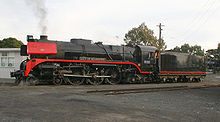
Preserved locomotive R 707 at the
Geelong locomotive depot in 2007
R 707, which due to various defects had still not been put into
service by 1954, was selected for modification for pulverised brown coal
(PBC) operation, in conjunction with trials of this fuel being
undertaken with
X class 'Mikado'
X 32. While the PBC locomotives performed well, the expense of
installing storage and handling facilities became increasingly
uneconomic with falling prices for fuel oil and the success of
diesel-electric traction. The conversion had also reduced the water
capacity of R 707's tender such that there was insufficient margin for
delays or bad weather running on many routes, confining the locomotive
to the shorter
Melbourne -
Geelong and
Melbourne -
Seymour lines.
[17] The experiments were discontinued and R 707 was converted back to black coal operation in 1957.
[18]
R 719 and 748 were converted to oil-firing during the mid-1950s.
[19] They performed very well and were favourites among crews for their clean,
cinder-free running.
[17]
The reduced maintenance associated with their oil-fired operation meant
they also had the highest availability of any of the R class and as
such recorded the highest mileages of any of the class.
[20]
However, rising fuel oil costs and the ongoing dieselisation program on
the VR precluded any further locomotives from being converted.
Demise
Because they were superseded so early in their lives by more modern
forms of traction, and because they spent so much of their remaining
lives stored for seasonal grain traffic and/or in poor condition, the R
class achieved one of the lowest average mileages of any VR locomotive.
The lowest was that of R 716, which recorded just 88,909 miles
(143,085 km) in just four years of service before being withdrawn in
1956 and scrapped in 1962.
[20]
As the VR focussed its attention on diesel electric traction, steam
locomotive depots were gradually closed down and the remaining steam
fleet became a much lower maintenance priority. A particular problem was
the lack of feedwater treatment, which saw many R class locomotive
boilers condemned for severe corrosion well before the end of their
design life.
[7]
1967 marked the final year of the R class in general service with the
withdrawal of the final three operating in this capacity: R 742 on 23
June, R 735 on 24 July and oil-burning R 748 on 10 August 1967. After
this date, the remaining R class locomotives on the register were used
for special enthusiast workings. R 706, R 769 and R 749 continued in
this role until boiler and mechanical conditions made them too costly to
maintain and they too were withdrawn, leaving only R 707 and R 761 in
operable condition.
[7]
Scrappings had commenced with R 755 in 1960, which had been involved
in a serious rear-end collision with a freight train earlier that year,
and continued through the decade. By 1970, only seven of the class
remained intact. R 707 and R 761 continued to haul various special
trains until both were withdrawn in 1974 as their boiler certificates
expired, and with their withdrawal came the end of over a century of
mainline steam locomotive operation on Victorian Railways.
21st century steam: West Coast Railway's R 711 and R 766
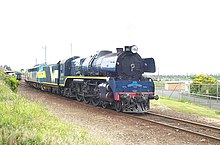
R 711, equipped with dual Lempor exhausts, resting at
Warrnambool, Victoria after hauling a West Coast Railway passenger service, 2001.
R class locomotives saw a relatively brief but notable return to
operation of regularly scheduled mainline passenger rail services when
in the late 1990s, two of the remaining locomotives were extensively
modified and returned to service. Private rail operator
West Coast Railway, which had successfully tendered for operation of the
Warrnambool railway line
in the privatisation of the Victorian passenger rail network, modified
the locomotives as part of an ambitious plan to operate steam-powered
express passenger services running to the same timetable as those
operated by modern diesel electric locomotives.
[21]
In order to ensure the locomotive's ability to reliably keep to the
timetable, a number of notable design changes were made. These included
the replacement of the original single blastpipe with dual
Lempor ejectors, conversion to oil firing, fitting of power reverse, and the addition of a diesel control stand to allow for
multiple unit operation with diesel electric locomotives where required.
[22] R 711 entered service on regular trains on 21 November 1998,
[23] and design refinements based on its performance in service were made to the subsequent conversion of R 766.
[24]
For a number of years, the modified R class locomotives could be seen in regular operation between
Melbourne and
Warrnambool, keeping a fast 3 hour 13 minute schedule which included six stops along the 267 km (166 mi) route.
[21] In 2004, West Coast Railway ceased operations after a number of operational problems made the business unviable.
[25] The two R class locomotives made a final trip back to
Newport Workshops, where they passed into the care of
Steamrail Victoria.


