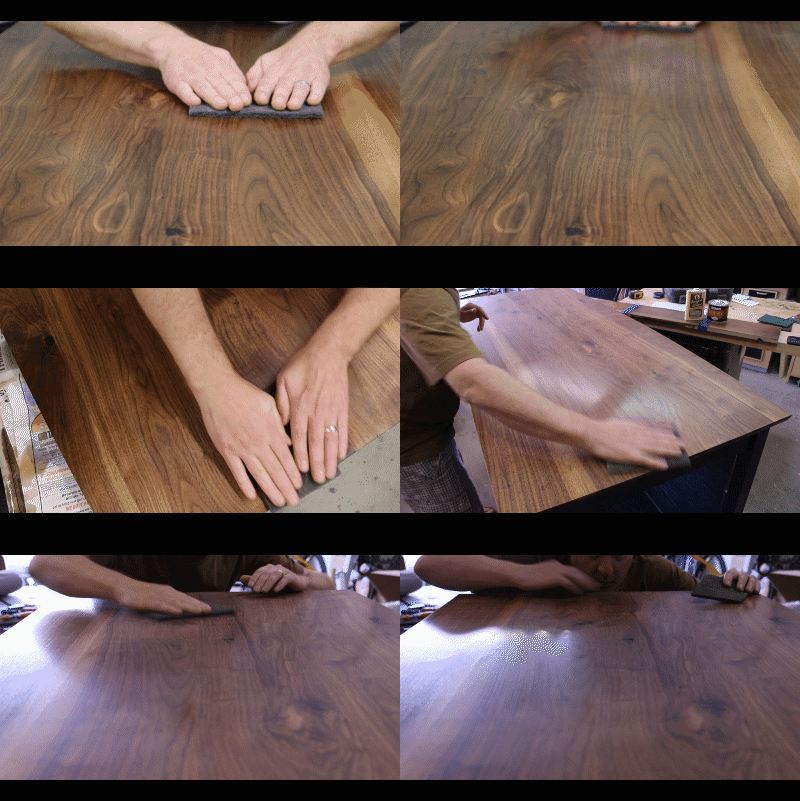
It's something we all use. A bit of a long article, but well worth the read. You'll find a few fascinating facts, too!
Sandpaper
Although the most familiar types of coated abrasives are probably the
individual sheets of sandpaper with which home woodworkers prepare
furniture or crafts for painting, the trade term "coated
abrasives" actually encompasses a much wider array of products for
both individual and industrial use. While these products assume many
forms, all are essentially a single layer of abrasive grit attached to a
flexible backing. In addition to their best-known form, sandpapers are
also available to consumers on belts, rolls, and disks. However, the
biggest users of coated abrasives are manufacturers who employ large-scale
abrasives in various phases of industrial production. For example, coated
abrasives are critical in both the furniture and automotive industries.
Coated abrasives date as far back as the thirteenth century, when the
Chinese used crushed shells and seeds glued with natural gum to parchment.
By 1769 coated abrasive paper was being sold on the streets of Paris. An
1808 article describes a process for making coated abrasives, and in 1835
a United States patent was issued for a machine that produced coated
abrasives.
Not always a highly versatile tool, coated abrasives were originally
restricted to finishing applications such as polishing or preparing
surfaces for painting or plating. Through improvements in the strength of
backings and the properties of abrasive minerals, coated abrasives now can
be used for heavy-duty applications. Today, industrial uses for coated
abrasives range from hand polishing with sheets of coated abrasive to
grinding steel with large machines that use 300-horse-power electric
motors to drive belts several feet wide.
Currently, approximately forty companies manufacture or import jumbo rolls
in the United States. The size of the industry is limited because it
requires a substantial investment in equipment, raw materials, energy, and
labor. A larger number of companies convert the jumbo rolls into useable
products such as disks and belts.
Raw Materials
The name "sandpaper" is actually a misnomer, as most coated
adhesive products contain neither sand nor paper. Generally, they consist
of some type of
abrasive mineral, which can be organic or synthetic;
flexible backings; and adhesives. Other materials may be added for special
applications. Most companies that manufacture jumbo rolls of coated
abrasives purchase minerals and backing materials from independent
companies that specialize in making these items. Natural minerals come
from companies that mine and process the minerals, synthetic minerals come
from companies that specialize in such refractory materials, and most
backings come from fabric manufacturers.
The abrasive grain, the key part of coated abrasive products, may be
either a natural or synthetic mineral. Due to their extreme hardness,
natural minerals such as
garnet or emery (
corundum with iron impurities)
find limited use in products for wood-related applications, while crocus
mineral (natural iron oxide) is limited to use as a polishing agent
because of its softness. However, such natural minerals comprise less than
one percent of the abrasives market. Metalworking
applications require synthetic minerals exclusively because such minerals
offer consistent quality and can be specially manufactured with an
elongated structure that bonds well to flexible backings.
The use of a particular coated abrasive product determines the mineral
that will be used in that product. Aluminum oxide is the most common
abrasive, followed by silicon carbide. Because silicon carbide is harder
and sharper, it is used for applications involving glass and other
nonmetal materials. Aluminum oxide, which is the tougher abrasive, is used
for metalworking applications where high forces are common. Minerals
containing
zirconium alumina and alumina are typically used where
extremely rugged abrasives are needed, such as in foundries. Expensive and
extremely hard minerals such as diamond or cubic
boron nitride are
restricted to special polishing processes.
The sizes of abrasive grains range from fine particles that look like
flour (2,000 grit) to large particles that look like granulated
sugar
(60 grit). Finer grains are used for surface finishing applications and
larger grains for shaping and material removal applications. Recent
developments in making uniform and extremely small grain abrasives with
particles the size of air-born particulate in smoke have created
applications in fine polishing known as
superfinishing.
Other improvements include patented technology to cluster fine minerals
into small hollow spheres or conglomerates the size of conventional
grains. Such refinements have improved cutting ability and extended the
useful life of coated abrasive products.
The backing is the flexible platform to which the abrasive mineral is
attached. The development of coated abrasives as a versatile manufacturing
tool can in part be attributed to improvements in backing materials.
Without a strong and flexible backing, coated abrasives could not survive
rough handling or the effects of liquids that are often used as grinding
aids.
Backings come in four basic materials, each with unique attributes. Paper
is the lightest of the backing materials and also the weakest. Although
its lack of material strength limits paper's usefulness for hand
applications, its flexibility makes it ideal for applications in which the
coated abrasive must fit closely to the contour of a work piece. Graded on
a scale that increases with the physical weight of a ream, paper backings
come in weights rated A to F. Unless specially treated, paper cannot be
used with water or other fluids.
Backings made from woven fibers come in progressively heavier weight
designations of J, X, Y, M, and H and are typically made of cotton,
polyester, or
rayon.
The pattern of weave in the backing varies from fibers woven at 90 degree
angles to fibers overlaid at 90 degree angles and stitched together. A
less-common mesh or screen pattern is used for backings in materials
needed in wet, low-pressure applications. Fiber backings are made of
multiple layers of resin-impregnated cloth fibers that are used in some
dry, high-pressure applications. Film backings, a recent development, have
improved the effectiveness of coated abrasives in precision finishing.
Uniformly thick synthetic film can be used with special micron-sized
minerals to produce highly reflective finishing and precision dimensions
on parts.
The bond or adhesive is applied to the backing in two layers, each of
which serves a different purpose. The first layer of adhesive, called the
make coat,
holds the abrasive mineral to the backing. After the first layer of
adhesive and grain have been applied, a second adhesive, the
size coat,
is applied in varying thicknesses depending upon the kind of product
being manufactured. A thin layer of size coat leaves more of the abrasive
mineral exposed, yielding a product that cuts more aggressively. Thicker
layers of size coats, which cover more of the mineral, create a product
that cuts less aggressively but creates finer finishes.
The Manufacturing
Process
Applying the make coat to the backing
1
-
1 A typical sanding belt originates with the manufacture of a large roll
of coated abrasive containing an "X" weight cotton fabric
backing, 100 grit aluminum oxide, and resin bond. Production starts when
the make coat is applied to one side of the backing material.
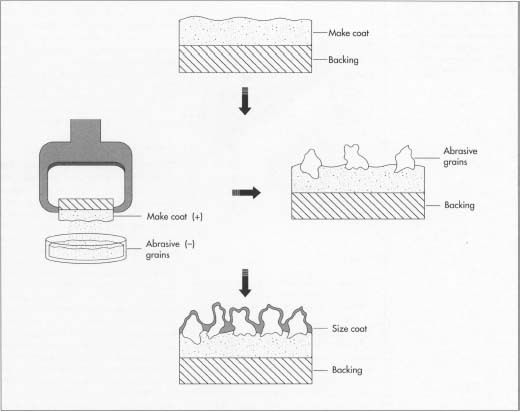
The term "sandpaper" is a misnomer, since most coated
abrasives contain neither sand nor paper. Instead, a typical coated
abrasive contains a backing of cotton, polyester, or rayon, with an
initial layer of adhesive backing—the make coat—applied
to it. The abrasive grains are then applied using an electrostatic
deposition process, in which the grains are given an electric charge.
Finally, another layer of adhesive—the size coat—is
applied.
Applying the abrasive to the make
coat
-
2 The next step, applying the abrasive mineral, is the most important in
the manufacturing process because it determines the orientation and
density of the mineral. In the past, the backing with the first layer of
adhesive passed under a controlled stream of abrasive, which applied a
thin layer of randomly oriented grit. Today, the backing is passed,
adhesive side down, over a pan of abrasives that have been
electrostatically charged—given an electric charge opposite to
the backing. The opposite charge causes the abrasive to adhere evenly to
the backing, resulting in a very sharp, fast-cutting coated abrasive
tool with the maximum life possible.
-
3 Controlling mineral density on the flexible backing gives rise to two
important variations in product design: open-and closed-coat abrasives.
An open-coat product contains abrasives grains that cover from 50 to 70
percent of the surface area of the backing. This lower density allows
the finished product to be flexible and prevents it from clogging or
loading with bits of work material. In closed-coat products, the mineral
covers 100 percent of the available surface area, making the finished
products better for finishing applications and more suitable for rougher
handling than open-coat products.
Applying the size coat
-
4 Once the grain has been imbedded in the make coat, the roll is dried
and moved on for application of the size coat. Following application of
the size coat, the roll is dried again and cured under carefully
controlled temperature and humidity conditions. The
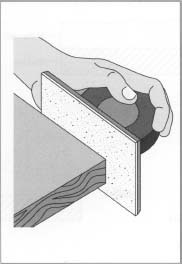
Sandpaper can take any number of sizes and shapes and can be used
for a variety of applications, from the common hand-held sheet shown
here to huge machines that use 300-horsepower electric motors to
drive belts several feet wide.
finished product is then wound on a large spool and shipped to the
companies that will convert it into sanding belts or other items.
-
5 Additional materials and processes may be included to give the
converted product special characteristics. One such treatment is the
addition of a grinding aid in the size coat that improves grinding of
some metals in high-pressure applications. Another treatment entails
applying a pressure-sensitive adhesive to the nonabrasive side of the
backing to make some types of sanding disks. Material may be also added
to reduce the static electricity that is generated when a belt is used
on wood. Passing the roll through two closely spaced steel rollers in a
process called
satining
crushes protruding minerals and leaves a product with uniform thickness
designed for fine finishing applications.
Flexing the roll
-
6 Before the coated abrasive roll is converted into a belt or other
product, it is systematically flexed or bent to break the continuous
layer of adhesive bond. This flexing is necessary because the freshly
manufactured roll is so stiff that it otherwise would not perform
properly when converted into other products. Flexing can be applied in
either a single direction or in multiple directions. Single direction
flexing breaks the bond usually at a 90 degree angle to the edge of the
roll. For special applications in which the belt must accurately conform
to contours of a part surface, single direction flexing is applied along
lines parallel to the sides of the belt. Multiple flexing breaks the
bond at 45 degree angles to the sides of the belt in a criss-cross
pattern or in a combination of 90 degree and 45 degree directions.
Although the latter produces a very flexible belt, such flexing greatly
reduces the useful life of the product.
Conversion
-
7 Converting roll material into abrasive belts starts with cutting
strips of coated abrasives to the desired width. Each strip is then cut
to the proper length, and the ends are joined together. The joint in
common belts is an overlapping splice at 45 degrees. Narrow belts are
spliced at a more acute angle and wide belts at a greater angle. A
variety of splicing techniques can be applied depending upon the
importance of changes in belt thickness at the slice and the amount of
stress the belt will receive during use. One common practice in
preparing a splice for joining is
skiving,
a process that removes a layer of abrasive or backing from the ends of
the belt. To minimize thickness of joints in products used for finishing
applications, both ends are skived. Coarse-grained products, which are
used for less precise applications, are skived on one end only.
Conversion of other products proceeds similarly. For example, sanding
disks begin with a properly sized section of roll material, and a
machine punches out the individual disks complete with the hole in the
center.
Quality Control
The quality of coated abrasive products is controlled by various
government and voluntary standards established by trade organizations
within the abrasive industry. These standards are primarily concerned with
safety and with the consistent grading and identification of products.
Safety standards appear in
American National Standards Institute (ANSI)
publication B7.7, and grain sizing and identification standards are in
ANSI publication B74. 18.
The Future
Coated abrasives will continue as reliable and useful tools for the
consumer and the manufacturing
industry, although changes in the use of some products are likely. For
example, as nonwoven abrasive products are improved and become better
recognized, they may replace some coated abrasives products. Continuing
development of minerals and backings will improve the performance of
existing coated abrasive products. New film backing and ultra-fine
abrasive minerals will enable new approaches to highly reflective and
precision finishes. Also, coated abrasives will be used more with
automated equipment as designs are improved and better computer controls
become available.
:o)
f