
Wednesday, October 8, 2014


A ride into town...
Not much going on - Just went in to town....
 |
| No traffic at all |
 |
| Some trees are bare already |
 |
| And some are just starting to change |
 |
| Uh-oh! Traffic ahead! |
 |
| Heading back |
 |
| I hate this S" bend - it's narrow and has a huge blind spot |
 |
| Where we turn off on the left |
 |
| One of the smaller farms |
 |
| The town recently graveled and oiled the road. Pot holes all gone! |
 |
| Some of the cows from the farm pictured below |
 |
| The milk tanker had just left |
 |
| And when we got home: two eggs! |
Some-days it's just like a whirlwind around here, 'ya know :o)
Tuesday, October 7, 2014
Don't miss it!
From: http://spaceweather.com
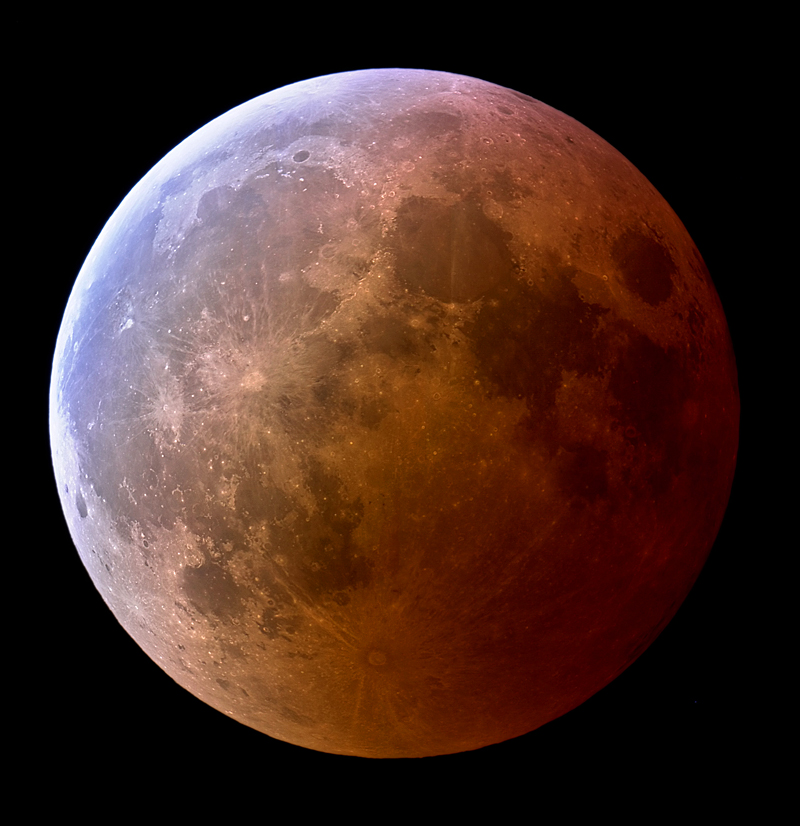
DON'T MISS THE LUNAR ECLIPSE: On Wednesday morning, Oct. 8th, there will be a total lunar eclipse.
Sky watchers in the Americas, Australia and most of Asia can see the
full Moon turn red as it passes through the sunset-colored shadow of
Earth: visibility map.
The show begins at approximately 9:15 UT (2:15 a.m. PDT) when the Moon
makes first contact with the core of Earth's shadow. Totality, when the
Moon is fully shadowed, begins at 10:25 UT (3:25 a.m. PDT) and lasts
for nearly an hour. Resources: NASA video, animated eclipse, live webcast.
During the eclipse, the Moon will look like this:

The hue of the lunar disk
may seem puzzling to some readers. Shadows are supposed to be black, yet
the shadowed Moon is mostly bright red. A quick trip to the Moon
explains the color:
Imagine yourself standing
on a dusty lunar plain looking up at the sky. Overhead hangs Earth,
nightside down, completely hiding the sun behind it. The eclipse is
underway. You might expect Earth seen in this way to be utterly dark,
but it's not. The rim of the planet is on fire! As you scan your eye
around Earth's circumference, you're seeing every sunrise and every
sunset in the world, all of them, all at once. This incredible light
beams into the heart of Earth's shadow, filling it with a coppery glow
and transforming the Moon into a great red orb.
Red isn't the only color,
however. Sharp-eyed observers might also spot some turquoise, shown here
in a photo taken by Jens Hackman during an eclipse in March of 2007:
Its source is ozone.
Atmospheric scientist Richard Keen of the University of Colorado
explains: "During a lunar eclipse, most of the light illuminating the
moon passes through the stratosphere where it is reddened by
scattering. However, light passing through the upper stratosphere
penetrates the ozone layer, which absorbs red light and actually makes
the passing light ray bluer." This can be seen, he says, as a soft
blue fringe around the red core of Earth's shadow.
To catch the turquoise on Oct. 8th, he
advises, "look during the first and last minutes of totality. The
turquoise rim is best seen in binoculars or a small telescope."Look at what she found!
Neighbor called me over to take a look at what she found in her weeping cranberry tree:


From: http://www.wasp-removal.com/wasp-nest.php
Wasp nests grow at varying rates depending on a variety of factors.
Food availability in early summer is a big factor in the growth of a wasp nest. If there is a shortage of food in early summer, the numbers of individual wasps will not be as high as "normal" years.
Available nest material is also important. Wasps strip untreated dead wood from fence panels or garden furniture and sheds which is converted into a paste that the wasps use to construct their nest.
 Despite age old rumours and misunderstandings, wasps do not swarm in
the same fashion as honey bees. Wasps only swarm around the nest
location when the nest is tampered with (under attack) such as when a
nest is treated. Wasps do swarm when feeding, but this will not be in
the area of the nest and not in the same fashion as honey bees.
When foraging scout wasps find a source of food, they return to the nest to communicate the location of the new food source. In late summer/autumn when wasps no longer have food supply in the nest, they can become a problem as they interact and compete with humans for sugary type foods, pub gardens are a good example.
In midsummer onwards into late autumn you will be able to easily tell if a nest is active or live. Take a few moments to watch the nest from a safe distance. If you can see wasps walking over the outside of the nest then it's live. Similarly if you can see wasps arriving at the nest and also leaving, the nest is live.
The queen will lay eggs in each cell as it is being constructed. Once these eggs have hatched out and gone through the developments stages and pupated into adult wasps, these new worker wasps take over nest construction and leave the queen solely to lay eggs and control the nest, this from now on is her primary function!
Read more detailed information about the wasp life-cycle and how wasp nests are built
The workers take this material back to the nest and hand it over to young wasp larvae which turn this chewed wood into a paste which the adult workers then use to continue expanding the nest. The paste which is used to construct the nest contains a certain amount of wax which helps with waterproofing.

How cool is that?!!
From: http://www.wasp-removal.com/wasp-nest.php
How wasp nests are constructed
The Wasp nest is a fascinating piece of engineering constructed from wood which the wasps strip from fence panels and garden sheds etc. The queen wasp starts building the nest from scratch in the spring after she emerges from winter hibernation (You can read about the life-cycle of the wasp).Wasp nests grow at varying rates depending on a variety of factors.
Food availability in early summer is a big factor in the growth of a wasp nest. If there is a shortage of food in early summer, the numbers of individual wasps will not be as high as "normal" years.
Available nest material is also important. Wasps strip untreated dead wood from fence panels or garden furniture and sheds which is converted into a paste that the wasps use to construct their nest.
Despite age old rumours and misunderstandings, wasps do not swarm in
the same fashion as honey bees. Wasps only swarm around the nest
location when the nest is tampered with (under attack) such as when a
nest is treated. Wasps do swarm when feeding, but this will not be in
the area of the nest and not in the same fashion as honey bees.When foraging scout wasps find a source of food, they return to the nest to communicate the location of the new food source. In late summer/autumn when wasps no longer have food supply in the nest, they can become a problem as they interact and compete with humans for sugary type foods, pub gardens are a good example.
In midsummer onwards into late autumn you will be able to easily tell if a nest is active or live. Take a few moments to watch the nest from a safe distance. If you can see wasps walking over the outside of the nest then it's live. Similarly if you can see wasps arriving at the nest and also leaving, the nest is live.
How Wasp Nests are made
The nest starts off in the spring with the queen building a petiole (a single stalk from which the nest hangs) and a single hexagonal shaped cell at the end of the petiole, then approx six more cells are formed around the centre one.The queen will lay eggs in each cell as it is being constructed. Once these eggs have hatched out and gone through the developments stages and pupated into adult wasps, these new worker wasps take over nest construction and leave the queen solely to lay eggs and control the nest, this from now on is her primary function!
Read more detailed information about the wasp life-cycle and how wasp nests are built
Why are some wasps aggressive and some calm?
The queen also determines the “mood” of the nest, some are very aggressive, some are not so, it all depends on the individual queen. She emits a pheromone throughout the nest that signals to the workers that either everything is ok, or the nest is in danger etc.What is a wasp nest made from?
The wasp nest is made from chewed wood, as nests are being established in the spring the queen wasp will start to gather old dead wood from untreated fence panels or sheds, even garden furniture. As the nest progresses and worker wasps have hatched, they take over nest material collection duties.The workers take this material back to the nest and hand it over to young wasp larvae which turn this chewed wood into a paste which the adult workers then use to continue expanding the nest. The paste which is used to construct the nest contains a certain amount of wax which helps with waterproofing.
How cool is that?!!
Today's funny :o)
The Bagpiper
Time is like a river. You cannot touch the water twice, because the flow that has passed will never pass again. Enjoy every moment of life.
“As a bagpiper, I play many gigs. Recently I was asked by a funeral director to play at a graveside service for a homeless man. He had no family or friends, so the service was to be at a pauper's cemetery in the Nova Scotia back country.
As I was not familiar with the backwoods, I got lost and, being a typical man, I didn't stop for directions.
I finally arrived an hour late and saw the funeral guy had evidently gone and the hearse was nowhere in sight. There were only the diggers and crew left and they were eating lunch. I felt badly and apologized to the men for being late.
I went to the side of the grave and looked down and the vault lid was already in place. I didn't know what else to do, so I started to play.
The workers put down their lunches and began to gather around. I played out my heart and soul for this man with no family and friends. I played like I've never played before for this homeless man.
And as I played "Amazing Grace", the workers began to weep. They wept, I wept, we all wept together. When I finished, I packed up my bagpipes and started for my car. Though my head was hung low, my heart was full.
As I opened the door to my car, I heard one of the workers say, "I never seen anything like that before, and I've been putting in septic tanks for twenty years."
Apparently, I'm still lost, it's a man thing.”
Another beautiful day!
It was a lot warmer yesterday than Sunday and just as nice


If you are stuck inside an office all day - I've got 'ya covered!
This is what Hubby did most of the day - he'll be back at it tomorrow and

in another two months he'll be sitting on a tractor with a plow in front of it!
Monday, October 6, 2014
The last one
Yesterday was the last of the major car shows in our area.
Oldest son and Hubby did not want to miss it.
Poor guys! Now they have to wait until next Spring!
Subscribe to:
Posts
(
Atom
)